The Parasite That Turns Insects Into Zombies
A fungus tells a carpenter ant exactly when to die — and the ant obeys.
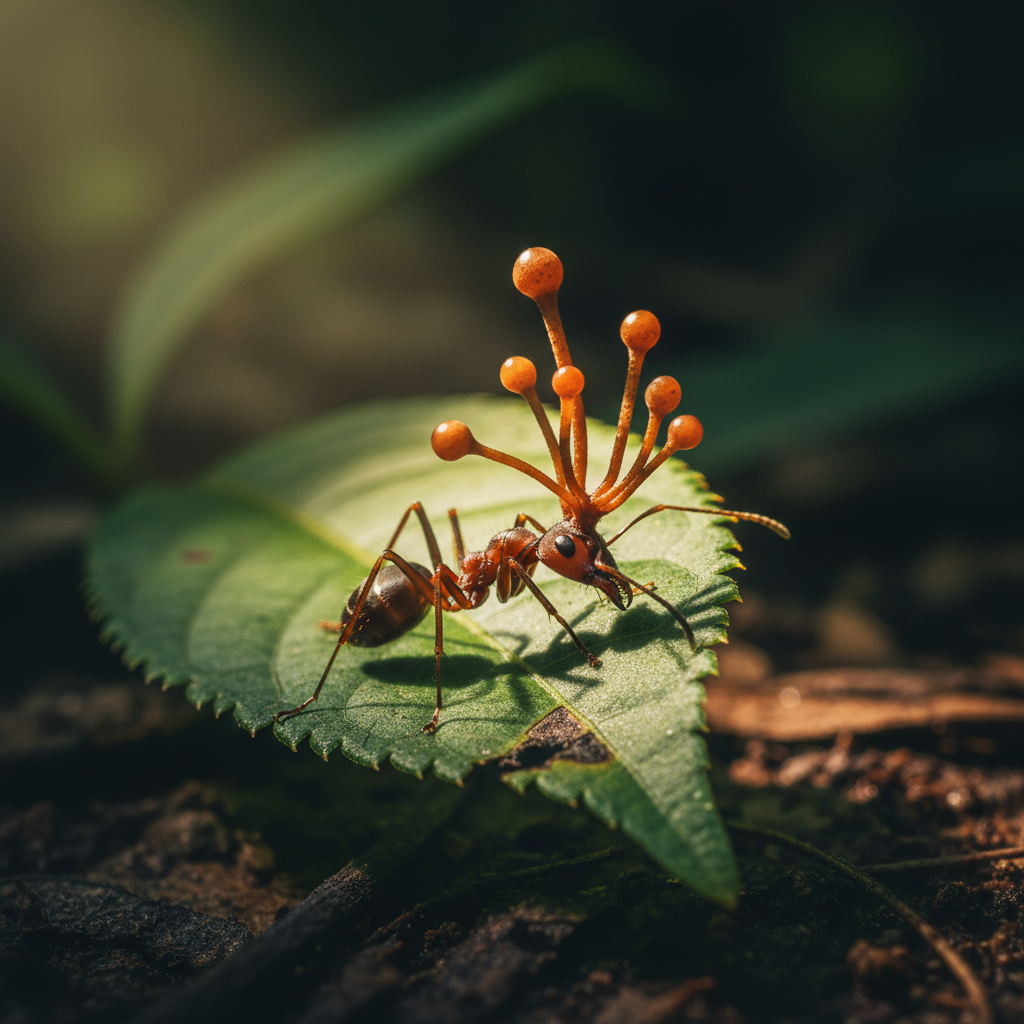
A fungus tells a carpenter ant exactly when to die — and the ant obeys.
It's called Ophiocordyceps unilateralis. Spores land on the ant's exoskeleton, drill through the cuticle, and grow inside its body cavity, threading the muscles like wiring through a wall. Within days, the fungus owns the nervous system in ways biologists are still trying to map.
At a precise time of day, the infected ant climbs. It leaves its colony, marches up a stem to a leaf roughly 25 centimetres above the forest floor — almost always on the north side, in the exact humidity the fungus needs to reproduce. Then it bites down on the leaf's main vein and locks its jaws there forever. This is called the "death grip", and the muscles have already been chewed away from the inside, fused in place so the corpse can't fall.
A stalk pushes out of the back of the dead ant's head a few days later. From the top of that stalk, the fungus rains new spores down onto the trail below — directly over the foraging routes of the ant's sisters.
The strangest part isn't the mind control. It's how surgical it is. When researchers sliced infected ants and imaged the tissue, they found the fungus had grown around the brain without invading it. The brain was untouched. The fungus was driving the body without ever touching the cockpit.
There are hundreds of Cordyceps species, and most specialise on a single host: one for tarantulas, one for cicadas, one for moths. Each one has worked out, over millions of years, exactly which strings to pull on exactly one kind of nervous system.
Somewhere in a rainforest right now, a beetle is climbing somewhere it never meant to go.
Sources (2) — tap to view
The Fish That Generates Its Own Electricity
One unbelievable thing. Every Sunday.
60 seconds. No spam. Unsubscribe anytime.
🦖
Discussion (0)
Loading…