
Why Mountain Air Starves Your Lungs
The percentage of oxygen at the top of Everest is the same as at sea level, but your lungs can't grab it.
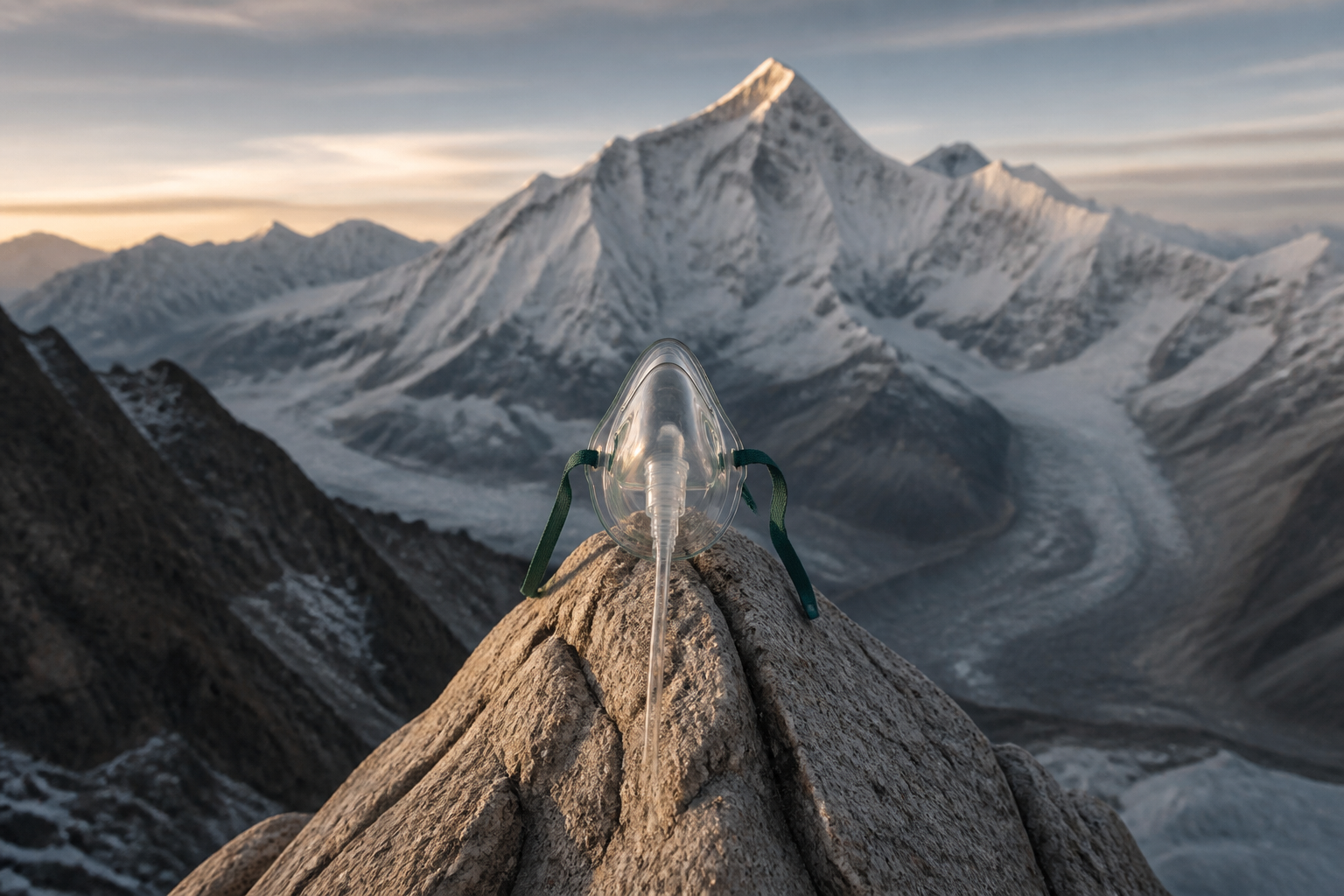
It is a myth that there is "less oxygen" at the top of a mountain. Whether you are at the beach or the peak of Everest, oxygen makes up exactly 20.9% of the air around you.
You struggle to breathe because the air pressure is too low to force that oxygen into your blood. At high altitudes, the weight of the atmosphere sitting on top of you decreases. This makes the air molecules—including oxygen—spread out so thin that each breath you take contains fewer molecules than it would at sea level.
Your lungs rely on pressure to drive oxygen across the thin membranes into your red blood cells. When the external pressure drops, that exchange slows down. At the summit of a high peak, your body might only be absorbing half the oxygen it is used to, even though the gas is present.
To compensate, your brain triggers a massive spike in heart rate and forces your kidneys to flush out bicarbonate to balance your blood's pH. This is why climbers often feel a sudden, crushing headache as their brain swells from the lack of pressure.
If you were suddenly teleported from sea level to the top of Everest, the pressure drop is so severe you would lose consciousness in less than three minutes.

The jellyfish that's biologically immortal
One unbelievable thing. Every Sunday.
60 seconds. No spam. Unsubscribe anytime.
🦖
Discussion (0)
Loading…