
There is a hole in your vision. Why can’t you see it?
Each eye has a patch with no light detectors, yet the world rarely looks as though anything is missing.
now, you are looking at the world through two physical holes…
Why does your brain fill in the 'blind spot' in your vision?
- Each eye has a patch with no light detectors, yet the world rarely looks as though anything is missing.
- But close one eye and the hole still does not usually announce itself.
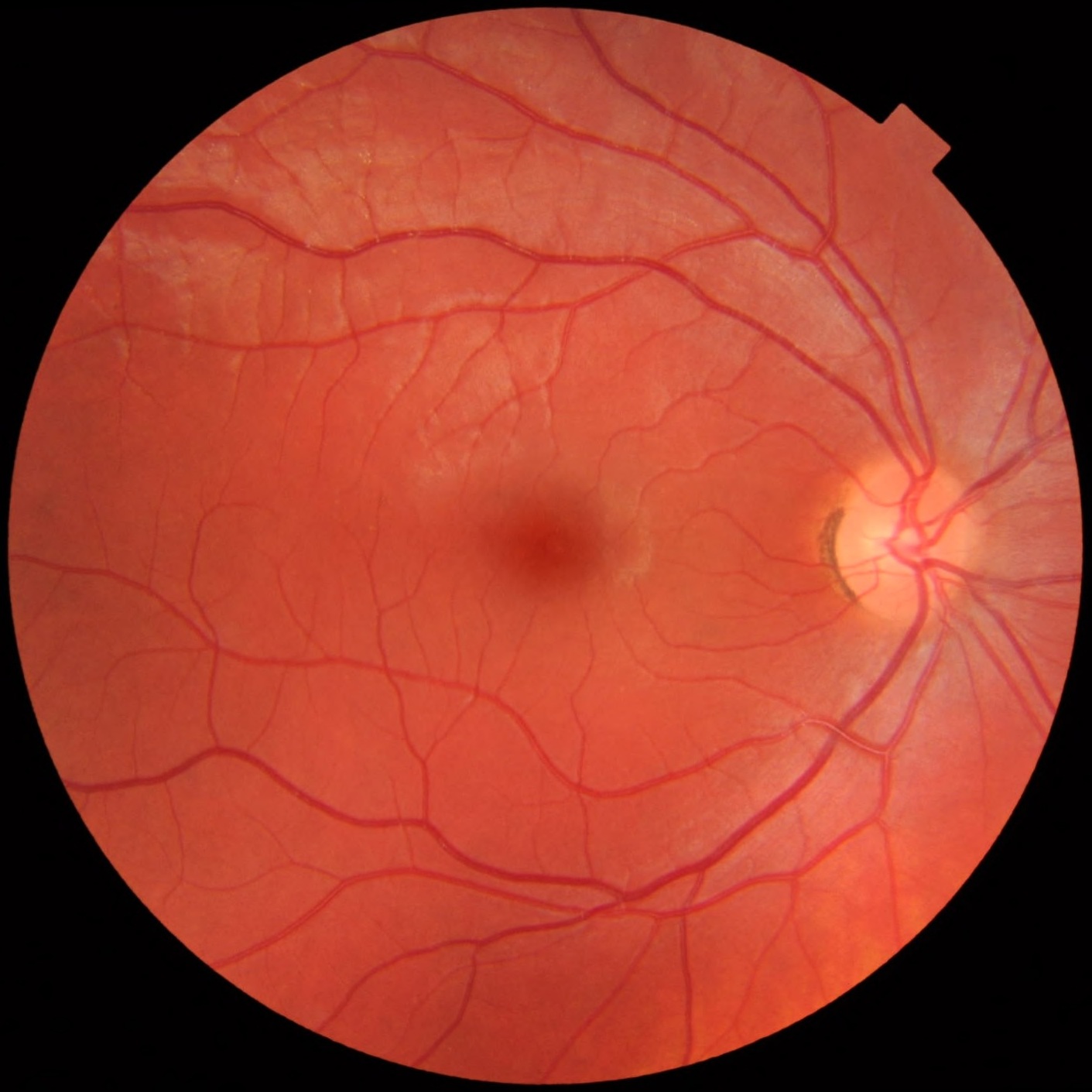
- Image: normal retinal photograph by Mikael Häggström, CC0.
There is a patch in each eye that cannot detect light at all. You have been looking through those gaps your entire life, usually without noticing them.
This is not a faulty eye. It is part of the wiring. The optic nerve leaves the retina at a region called the optic disc, and that region has no rods or cones, the cells that respond to light. Anything whose image falls entirely there supplies no visual signal from that eye.
So why does your view of the room not contain two obvious holes?
One answer is that your eyes cover for each other. Their blind spots occupy different positions in the visual field. With both eyes open, something landing on one eye’s blind spot can usually be seen by the other. Binocular vision provides actual information, not invented detail.
But close one eye and the hole still does not usually announce itself. That is where perceptual completion becomes interesting. A plain background can appear continuous across the gap. A line crossing it can seem unbroken. Surrounding colour, texture and shape influence what you perceive where one eye supplies no information.
This does not mean your brain paints a perfect hidden picture. Put a small isolated mark in the right place and it can disappear rather than being faithfully reconstructed. The visual system cannot recover an unseen word or identify an unknown object just because it lies in the blind spot. A convincing sense of continuity is not the same as an accurate record of everything outside you.
Researchers have found brain activity associated with filling-in, but the exact neural mechanisms remain an active research question. Different completion effects need not all work identically. Calling the process a deliberate lie, or saying the brain simply dislikes gaps, explains less than it seems to.
The everyday surprise is not that your eyes are useless. It is that seeing feels complete even when the incoming information is incomplete. Your experience of a continuous world depends on both what reaches your eyes and how your visual system organizes it.
Image: normal retinal photograph by Mikael Häggström, CC0. The bright optic disc is where the optic nerve exits. Original photograph used without alteration.
How did this hit you?
Or say it in words - one line is enough.
Two questions from this article.
Both right earns +50 XP. No account needed.
Sources (3) - tap to view
The Ultimate Trivia Pack
100 questions worth asking out loud. Free, printable, and ready on your phone.

Discussion (0)
Add your name and join in. No account needed.
Loading…