Why We Dream
After a century of sleep labs, MRI scans and theories, nobody knows what dreams are actually for.
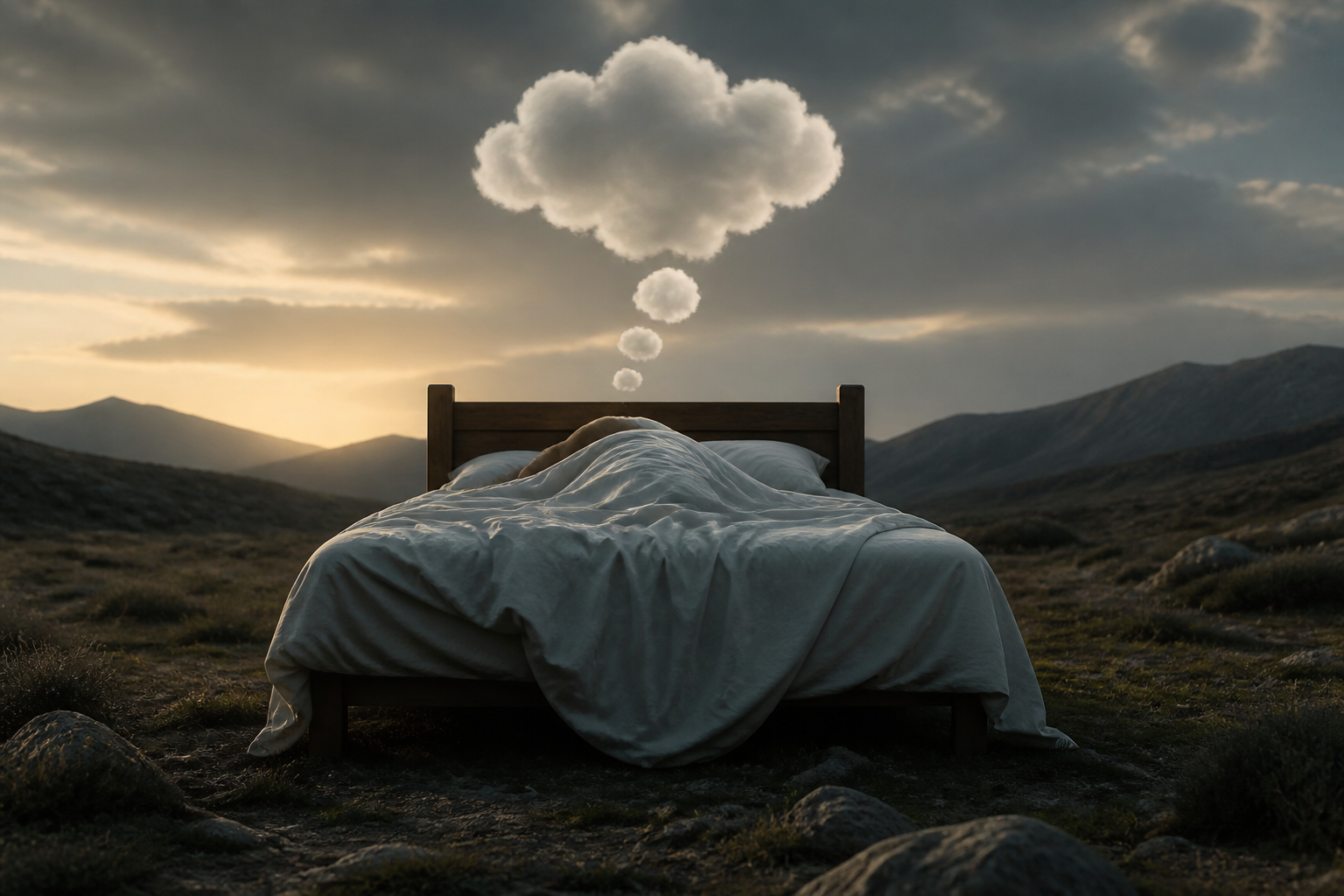
If you were forced to watch a movie every night where the plot kept changing, the actors were people you hadn’t seen in years, and gravity was optional, you would probably question your sanity. Yet, your brain does this intentionally for about two hours every single night.
Scientists can track exactly when it happens by watching your eyes dart beneath your lids, but they cannot agree on why it happens at all.
One theory suggests dreaming is just biological noise. As your brain consolidates memories from the day, it fires off random electrical impulses. Your conscious mind, desperate to make sense of the internal static, stitches these sparks into a narrative. Under this logic, your most vivid dreams are essentially your brain hallucinating to cover up its own background hum.
But this does not explain why we feel such intense emotion during the process. In a dream, your amygdala—the brain’s threat-detection center—is firing at full capacity, while the lateral prefrontal cortex, which handles logic and impulse control, is effectively powered down.
This creates a "biological simulator" where you can experience the terror of being chased without moving a single muscle in your bed. It is a dress rehearsal for survival, allowing you to practice reacting to life-threatening scenarios in a safe environment.
If this were the only purpose, however, why do we dream about mundane things like losing our teeth or forgetting to study for a test we took a decade ago?
There is a chemical shift that occurs only during REM sleep that may hold the answer. The brain completely shuts off the supply of norepinephrine, a chemical associated with stress. This makes dreaming the only time in your entire life when your brain is completely free from anxiety-inducing molecules, even while it reprocesses traumatic or difficult memories.
You are effectively performing self-administered therapy, stripping the painful emotional sting away from your experiences so they can be stored as neutral data.
Even so, these are all just sophisticated guesses. We still do not know if the dream is the goal of sleep, or if the dream is simply the exhaust fumes of a much more complicated engine running in the dark.
We spend a third of our lives in a state that science can describe, but cannot explain.

The Crimson Mirror That Turns Animals Into Stone
One unbelievable thing. Every Sunday.
60 seconds. No spam. Unsubscribe anytime.
🦖
Discussion (0)
Loading…